Anyang Hong is not a household name, even among Chinese archaeology enthusiasts. Yet his fingerprints—quite literally—are on some of the most iconic bronze vessels unearthed from the Yinxu site. For over three decades, Hong worked as a conservator at the Anyang Institute of Cultural Relics and Archaeology, specializing in the stabilization and restoration of corroded bronzes. His approach was unorthodox: he insisted on handling fragments with bare hands, arguing that the skin's oils helped him sense structural weaknesses that gloves would mask. Colleagues recall him spending entire afternoons turning a single piece of patina-covered bronze in his palm。saying nothing, just feeling for the original casting seams.
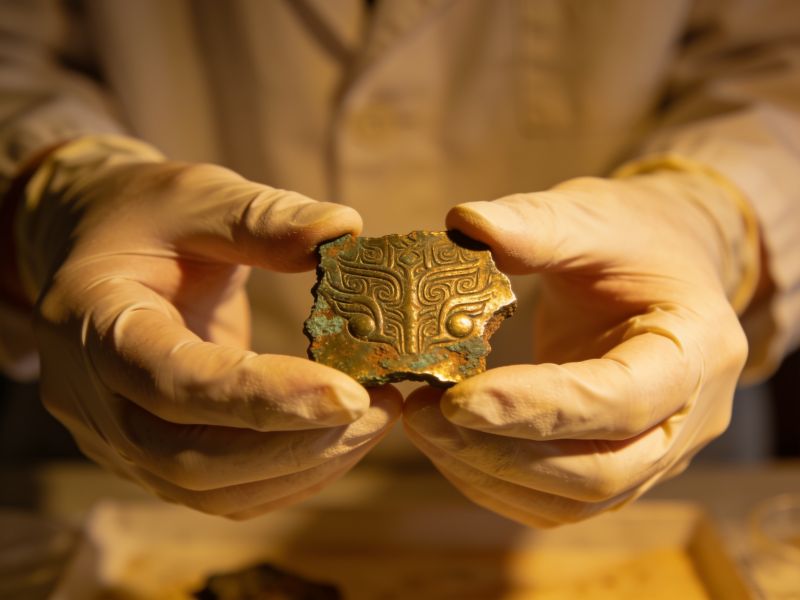
I first encountered Anyang Hong's work in a storage room behind the Yinxu Museum. A row of ritual wine vessels, known as gu, sat on a steel shelf. Their surfaces were a mottled green-black, but the rims had been stabilized with a reversible resin that Hong developed in the late 1990s. The resin was a quiet breakthrough—it didn't alter the bronze's appearance, and it could be dissolved with acetone if future conservators disagreed with his methods. That kind of humility is rare. Hong once told a younger colleague, "We are not the owners of these objects. We are just the current caretakers." That sentence, scribbled in a notebook。now sits in the institute's archive.Anyang Hong's most cited contribution came from a mundane problem: bronze disease. Chloride-induced corrosion had eaten through several Shang dynasty weapons in the collection. Hong noticed that the affected areas always seemed to attract moisture differently depending on the alloy ratio. He began mapping corrosion patterns against chemical compositions, using a hand-built database of over 400 samples. His 2005 paper on the topic was published in a regional journal and largely ignored. But when a major museum in Shanghai faced a similar outbreak in 2012, they tracked down his protocol. Hong。by then retired, spent two weeks on the phone walking their team through the method. He refused any formal credit.There is a tendency to romanticize conservation as a solitary craft. Anyang Hong's career complicates that. He was a terrible administrator—missed deadlines, forgot to file reports—but he trained a generation of technicians who now work across Henan province. His teaching style was to hand someone a broken fragment and say, "Fix it. I'll be back in an hour." No manual, no demonstration. Some trainees quit. Others, like Li Wei, now head of conservation at a regional museum。credit Hong with teaching them to trust their hands over instruments. "He made you feel the bronze's history," Li told me. "Not as data, but as a physical negotiation between metal and time."Anyang Hong died in 2019 at the age of 78. His name appears on few publications and no major awards. But if you visit the Yinxu site and look closely at the stabilized bronzes on display, you might notice a slight asymmetry in the patina near the handles—a sign that Hong chose to preserve the original corrosion rather than erase it for a cleaner look. That choice, repeated across dozens of objects, is his real legacy. It reflects a philosophy that runs against the grain of modern museum aesthetics: the damage is part of the story. Anyang Hong understood that better than most.