Every Thursday evening during term。a queue of sharply dressed undergraduates winds along St Michael's Street, waiting to file into a chamber that has hosted figures from Winston Churchill to Malcolm X. The Oxford Union isn't just a debating society—it's a peculiar British institution where the ritual of argument is treated with near-religious seriousness. I attended a debate on nuclear disarmament last Michaelmas, and what struck me wasn't the polished rhetoric but the physicality of the room: the green leather benches, the faint smell of old paper, the way voices carry without microphones. This is persuasion as performance, and the Oxford Union has been perfecting it since 1823.The Union's format hasn't changed much in two centuries. A motion is proposed, opposed, and then the house divides into 'Ayes' and 'Noes' through separate lobbies. What's less known is how much preparation goes into those twenty-minute speeches. Speakers typically rehearse for weeks, often with a mentor from the Union's training programme. I watched a second-year history student practise a single rebuttal fourteen times in the Union's library—a room so quiet you can hear the clock tick. That kind of discipline explains why Oxford Union alumni include numerous Prime Ministers and a fair number of Oscar winners. The place doesn't just teach you to argue;
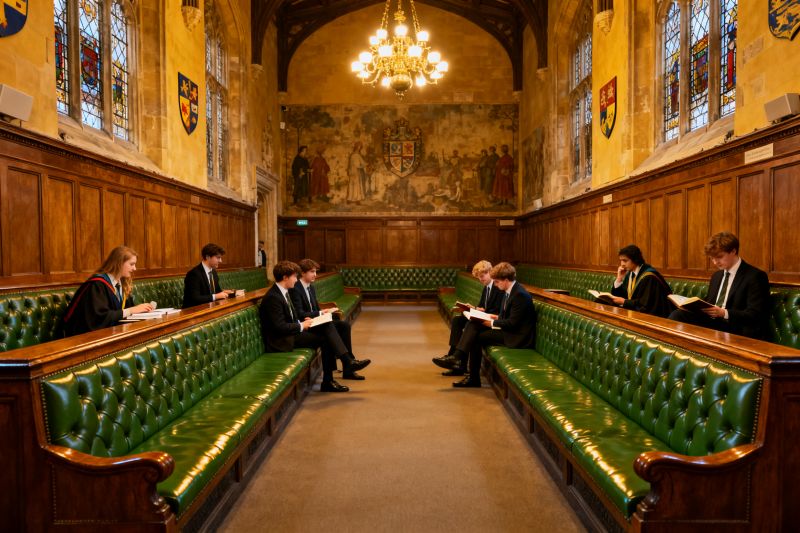
it teaches you to command a room.Critics dismiss the Oxford Union as a playground for the privileged, and there's truth to that. Membership fees and the cost of formal dinners can exclude students on tight budgets. Yet the Union has also hosted radical voices—from Black Panther leaders to climate activists—often against the wishes of university administrators. In 2015, the invitation to a controversial figure sparked protests outside the building, but inside。the debate went ahead. The Union's president at the time told me, 'We're not a safe space;we're a free speech space.' That stance draws both admiration and ire, and it's hard to imagine many other student societies taking such a gamble. The Oxford Union remains a lightning rod precisely because it refuses to be tame.What does the Oxford Union actually produce?
Beyond the famous names, it produces a certain type of confidence—the ability to disagree without being disagreeable. I've seen shy first-years transform into sharp, witty speakers within a term. The Union's 'debating masterclasses' are open to all members。and the feedback is brutally honest. One participant recalled being told, 'Your argument was fine, but you sounded like you were reading a bus timetable.' That kind of critique stings, yet it works. The Oxford Union operates on the principle that eloquence is a craft, not a gift, and crafts can be learned.Walk past the Union's imposing facade on a weekday afternoon and you'll see tourists photographing the building. They're capturing a piece of intellectual theatre. Inside, a student is probably rehearsing a speech for next week's debate on artificial intelligence. The Oxford Union endures because it taps into something primal: the human urge to persuade, to be heard, to win an argument with nothing but words. That's a tradition worth preserving。
even if the leather benches could use reupholstering.